


GM Says They Fixed One of the Most Frustrating Towing Issues on the 3.0 Duramax Diesel — But Some Owners May Have to Pay for the Update

March 2026 — General Motors has released updated service guidance that appears to address one of the most commonly reported frustrations among owners of the 3.0L Duramax diesel: confusing Diesel Exhaust Fluid (DEF) warnings that appear shortly after beginning a towing trip.
For several years, some Silverado and Sierra owners towing trailers have reported the same scenario. Shortly after starting a tow, the truck suddenly displays low DEF warnings or an empty DEF tank message, even though the tank had recently been filled. In some cases, adding more DEF does not immediately clear the warning, creating the impression that something in the emissions system has failed.
Two updated GM service bulletins released in March 2026 now explain both why the issue occurs and how GM says it has corrected it.
However, the bulletins also reveal a detail that may frustrate some owners: the corrective procedure appears to be covered only under bumper‑to‑bumper warranty coverage, meaning vehicles outside the basic warranty period could require owners to pay for the update.
GM Acknowledges the Towing DEF Warning Issue
The first bulletin involved is 24‑NA‑196, titled:
“Information on Complaint of Empty DEF Tank Shortly After Beginning a Towing Trip and/or Unable to Properly Fill the DEF Tank.”
In the Condition section, GM acknowledges that some customers may experience:
An empty DEF tank message shortly after beginning a towing trip
A situation where the vehicle does not recognize a DEF refill
According to the bulletin, this behavior can occur during high‑load towing conditions, when the diesel engine is producing higher levels of nitrogen oxide (NOx). To control those emissions, the Selective Catalytic Reduction (SCR) system increases the rate at which DEF is injected into the exhaust.
As DEF consumption rises under heavy load, the system’s warning strategy may activate earlier than drivers expect.
During this stage, the DEF gauge may display very little fluid—or sometimes no bars at all—even though some DEF remains in the tank.
The bulletin explains that the system intentionally hides part of the remaining fluid reserve while the emissions warning strategy progresses. This design can make the tank appear empty even when the vehicle still has enough DEF remaining to complete the inducement countdown.
That visual behavior often leads drivers to immediately add DEF.
But GM notes that during the early portion of the warning strategy, the system may not detect a refill event, meaning the warning message may continue even after fluid is added.
Previously, dealers often told customers that this was normal and instructed them to “monitor” the DEF level and add fluid only under specific conditions. The new bulletin effectively replaces that guidance with a more precise description of how the system is actually behaving.
The bulletin now instructs that the correct time to add DEF is when the system transitions to the speed‑limiting warning stage, which typically warns that the vehicle will soon be limited to 65 mph.
At that point, the system will reliably detect the refill and reset the warnings.
Pickup Trucks Are Directed to a Separate Bulletin
While bulletin 24‑NA‑196 explains how the DEF system behaves under heavy towing loads, it also includes an important note for pickup trucks.
For 2023–2026 T1 pickup trucks, including the Silverado and Sierra equipped with the 3.0 Duramax, technicians are directed to bulletin 22‑NA‑150.
This second bulletin contains the actual correction procedure for inaccurate DEF warnings.
Bulletin 22‑NA‑150: Software Update and System Reset
Bulletin 22‑NA‑150 addresses conditions where drivers may experience:
Malfunction Indicator Lamp (MIL) illumination
Service Emission System messages
Incorrect DEF level readings
Erratic or stuck DEF level sensor behavior
GM states the issue can be caused by a system anomaly requiring a software update and reset procedure.
The repair process focuses on recalibrating how the vehicle interprets DEF tank data.
Technicians are instructed to:
Verify that the Reductant Control Module is running the latest calibration.
Check the DEF level values using GM’s GDS2 diagnostic system.
Add one gallon of DEF during testing.
Perform a Reductant Fluid Tank Level Reset to allow the system to relearn the tank level.
The system monitors two different data points when calculating DEF level:
A learned reductant level, representing the calculated percentage of tank volume.
A sensor output value, representing the actual fluid height inside the tank.
If those two values drift apart, the vehicle may display warnings that do not accurately reflect the true fluid level.
Resetting the system allows those values to be synchronized again.
Functionally, this bulletin marks a shift from “this is normal” to “this is a system anomaly that needs to be corrected with updated software and a guided reset.”
New Software for 2023–2026 Diesel Trucks
The March 2026 revision of bulletin 22‑NA‑150 adds another important update.
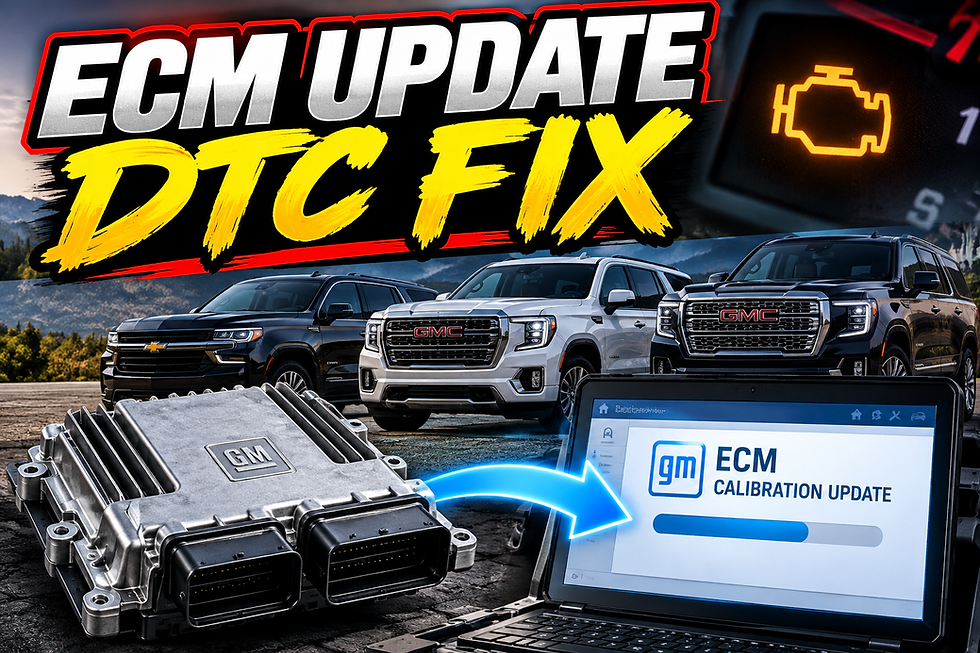
GM now states that new software is available for 2023–2026 light‑duty and heavy‑duty
pickups equipped with the LZ0 or L5P diesel engines.
This update reprograms the instrument cluster messaging related to the DEF system in order to clarify how warnings are presented to drivers.
The update is installed through GM’s Service Programming System (SPS2) and does not require replacing any DEF system components.
This also implies that trucks previously updated under an earlier version of 22‑NA‑150 may now be running an older calibration, even if they were told they already had “the latest” software at the time.
Warranty Coverage Raises Questions
While the bulletins describe the corrective procedures, they also specify how the repairs are covered.
The labor operation listed for confirming DEF system operation under bulletin 24‑NA‑196 is tied to bumper‑to‑bumper warranty coverage.
That detail could be significant for some owners.
The basic bumper‑to‑bumper warranty on most GM trucks lasts 3 years or 36,000 miles, meaning trucks outside that window may not qualify for the repair under warranty.
Because the issue appears related to system logic and messaging rather than a clear hardware failure, some owners may find themselves paying for the diagnostic and software update even though GM has now documented the condition in its own service guidance.
This creates a situation where GM is effectively acknowledging the behavior as a known issue, but not necessarily treating it as a defect that must be corrected at no cost beyond the basic warranty period.
What the Updated Bulletins Show
The March 2026 revisions to these service documents provide the clearest explanation yet of why some Duramax owners experience confusing DEF warnings while towing.
Bulletin 24‑NA‑196 acknowledges the towing‑related warning behavior and explains how the DEF system’s inducement strategy can make the tank appear empty earlier than expected.
Bulletin 22‑NA‑150 provides the corrective procedure and newly released software intended to improve how the system calculates and communicates DEF levels.
Taken together, the updates show that GM has identified the cause of the warnings and implemented changes intended to correct the behavior on newer diesel trucks.
Just as importantly, they show a shift from telling owners the behavior is “normal” to documenting it as a system anomaly that can—and, in GM’s own procedure, should—be corrected. For owners outside the basic warranty window, the remaining question is whether they will have to pay to get that fix.
Comments