


GM Confirms P2002 Codes Can Be Triggered by OTA Updates on the 3.0L Duramax

If you’ve been following recent discussions surrounding the 3.0L Duramax, especially the growing number of owners suddenly seeing a P2002 code appear immediately after an over-the-air update, General Motors has now officially acknowledged the issue.
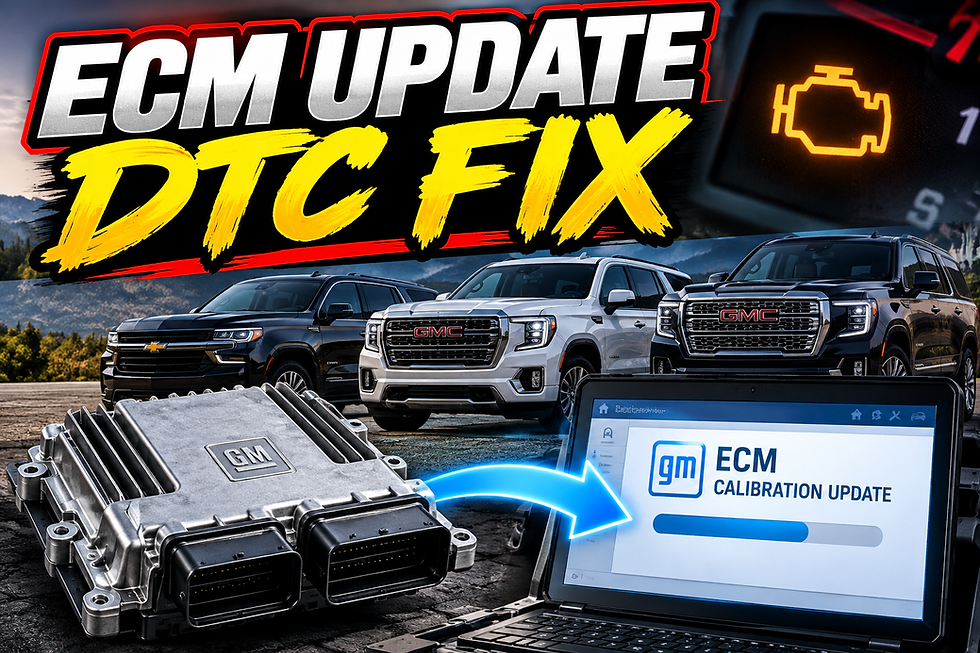
GM just released bulletin # 26-NA-168, titled “LZ0 with P2002 Set After an Over The Air (OTA) Update,” and it directly confirms something many owners had already begun suspecting: in some cases, the truck may not actually have a failed diesel particulate filter at all.
This is especially interesting because the exact topic was recently discussed on the 3.0 Duramax Podcast, where concerns were raised about trucks suddenly triggering P2002 codes immediately following OTA software updates.
According to the newly released GM bulletin, certain 2023 Chevrolet Silverado 1500 and GMC Sierra 1500 models equipped with the LZ0 3.0L Duramax may illuminate the Service Engine Soon light after receiving an OTA update. The bulletin specifically states:
“If the vehicle has set P2002 after an OTA, this is likely an issue with the OTA. The vehicle does not need a particulate filter.”
That sentence alone is significant.
For months, many owners have feared that a P2002 automatically meant a cracked or failed diesel particulate filter (DPF), which can become an extremely expensive repair once out of warranty. But GM is now acknowledging that at least some of these faults are software-related and not the result of a physically damaged DPF.
What Is a P2002 Code?
The P2002 diagnostic trouble code indicates that the diesel particulate filter efficiency is below threshold.
In simple terms, the engine computer believes the DPF is no longer filtering soot effectively enough. Traditionally, this could point toward:
A cracked DPF
Excessive soot bypass
Failed sensors
Exhaust leaks
Regeneration issues
Calibration problems
On the 3.0L Duramax, a true P2002 failure can become serious because the DPF is a major emissions component integrated deeply into the exhaust aftertreatment system.
However, what made recent cases suspicious was the timing.
Owners across social media and forums began reporting that the code appeared almost immediately after OTA updates were installed. In many cases, the trucks were otherwise driving normally with no obvious signs of DPF failure.
That concern was brought up directly during the recent podcast discussion.
The Podcast Discussion That Discussed This
During the podcast, the concern was raised that many of these trucks were suddenly setting P2002 codes right after software updates, leading to questions about whether the DPFs were actually failing at all.
The discussion specifically mentioned how unlikely it seemed for a healthy DPF to suddenly fail immediately after an OTA calibration event. The recommendation at the time was cautious but logical:
Inspect the tailpipe for excessive soot
Check whether soot is physically bypassing the filter
Clear the code
Drive the truck
Perform a regeneration if possible
See whether the code actually returns
That advice now aligns closely with GM’s own position in bulletin # 26-NA-168.
GM’s Official Repair Procedure
The repair procedure in the bulletin is surprisingly simple.
GM instructs dealers to:
Clear the P2002 code
Return the vehicle to the customer
That’s it.
The labor operation is listed as:
Labor Op: 2881408
Description: Clear Code after OTA
Labor Time: 0.04 hr
That alone tells you GM does not currently view these specific post-OTA P2002 events as legitimate hardware failures.
Why This Matters for 3.0L Duramax Owners
This bulletin matters because it may prevent unnecessary repairs and panic among owners.
DPF replacements can easily become several-thousand-dollar jobs once warranty coverage expires. Seeing a P2002 code naturally causes concern because historically it has often been associated with real hardware failure.
But this bulletin introduces an important distinction:
Not every P2002 on an LZ0 means the DPF is actually damaged.
If the code appeared immediately following an OTA update, there is now documented GM guidance acknowledging the update itself may be responsible.
That does not mean every P2002 should automatically be ignored. A truly failed DPF can still occur. Excessive soot accumulation in the tailpipe, failed regenerations, or repeat faults after clearing the code still deserve proper diagnosis.
But this bulletin provides some reassurance that software can absolutely be part of the equation.
What Owners Should Watch For
If your 3.0L Duramax suddenly sets a P2002 after an OTA update, there are several things worth paying attention to:
Did the code appear immediately after the update?
Is the truck otherwise driving normally?
Is there visible soot buildup at the tailpipe?
Does the code return after clearing?
Can the truck complete a regeneration normally?
Those details now matter more than ever.
Listen to the Podcast Discussion
The issue was discussed before GM released the bulletin, including thoughts on why the timing of these failures seemed suspicious and what owners could look for before assuming catastrophic DPF failure.
You can listen to the full podcast discussion here:
Final Thoughts
This is one of the more interesting bulletins GM has released recently because it highlights how modern OTA updates can directly affect emissions diagnostics and potentially trigger false failures.
As trucks become increasingly software-driven, situations like this may become more common. A check engine light no longer always points directly to broken hardware — sometimes the calibration itself becomes part of the problem.
For 3.0L Duramax owners, bulletin # 26-NA-168 is an important reminder not to immediately assume the worst when a P2002 appears after an OTA update.
And in this case, it appears the community discussions may have identified the pattern before the official bulletin was even released.
Comments